Sunday, 13 February 2011

The silliness is strong in this one...

I’m sure, my dear readers, that you all know about the Church of Jedi. A lot of very silly people decided to muck up their national census office’s statistics by putting their religion as Jedi. What started as a few nerds in New Zealand soon grew into an international phenomenon. There are officially more Jedi’s than Sikhs in the UK!

The big question than people ask (especially middle-aged women like my mum who don’t even know that Vader is Luke’s father) is why?

There are many answers. Some people were protesting against the inclusion of what they saw as an unnecessary and overly-personal question in a government document. Some I’m sure felt they were striking a blow against religion (this is an unpardonable generalisation I know but at the moment it seems that as soon as they reach about 14 teenage boys suddenly hate religion and all it stands for. It seems to wear of after a few years though fortunately...). But there are a few, just a brave few, who really believe it.

You’re scoffing I know. But when you get right down to it, Jediism is actually a pretty sensible belief system. They believe in the force, which connects all living beings together. If you know how you can shape the force to your own designs, use the energies to your advantage (chi, by any other name...). There is a dark side and a light side, and we must strive to be on the light side, by doing good deeds etc. If we do we will be able to perform miracles and live to extraordinary ages. It’s basically a mishmash of all George Lucas’ favourite bits of Eastern mysticism and belief. There’s bits of Taoism, Buddhism, Confucianism, Shinto, (and the obvious parallels between Luke Skywalker and Jesus) all mixed together with a side-order of robots (sorry, sorry... I did mean 'droids, honestly).

Ultimately though, most people who identify as Jedi don’t believe in it. They just thought it was funny, which, as Sir Terry Pratchett put it, just goes to show.

Quantum physics would agree that deep down, we’re all the Pope

Discordianism is based on a book, the Principia Discordia by the incredibly named Malaclypse the Younger, “Wherein Is Explained Absolutely Everything Worth Knowing About Absolutely Anything”. The opening to an online edition of the Principia Discordia describes the author as “a time-travelling anthropologist from the 23rd Century, currently passing among us as a computer specialist, bon vivant and philosopher named Gregory Hill. He has also translated several volumes of Etruscan erotic poetry, under another pen-name, and in the 18th Century was the mysterious Man in Black who gave Jefferson the design for the Great Seal of the United States. Whenever I question him about this, he grows very evasive and attempts to persuade me that he is actually just another 20th Century Earthman.” I know it’s not really good form to post big quotes like that in a blog, but that just amused me.

They worship (sort of, though they don’t believe in prayer) the Greco-Roman goddess of discord and disharmony, Eris (as in the one who threw the golden apple that started the Trojan war). The Principia and their subsequent writings reference many historical figures, but undoubtedly the most interesting is the Emperor Norton I of San Francisco, a self-declared ruler who proclaimed himself sole dictator of the United States in the 19th century. So widely accepted was Norton as the town eccentric that, when he began to print his own money, a great many shops accepted it as legal tender! In this way, Norton embodies many of the principles of Discordianism – he did own thing, went his own way and was unafraid of looking ridiculous in public.

Essentially, Discordians dedicate themselves to seeing the funny side of life, the innate ridiculousness of all things and above all, to making people think for themselves. The fifth of the five laws of Discordianism is that you shouldn’t believe anything you read (presumably including the laws of Discordianism). They are also free from the militant anti-something or other feelings that pervade so many parody religions. They’re not anti-anything, just pro-silliness.

You may have noticed by now, dear readers of my blog, that I have a soft spot for parody religions, the sillier the better. Discordianism has a special place in my heart because quite frankly, they don’t come any sillier than this! It encourages a world where a crazy man can declare himself a king and print his own money, and instead of arresting him for treason or forgery people accept him, are proud of him and give him free food. That’s the world I want to live in.

Friday, 10 December 2010

I'm taking my oysters for walkies...

As I have mentioned before, many parody religions are actually trying to make a serious point and of none if this more true than of God Hates Shrimp. Yes really.

Now you may or may not have heard of the Westboro Baptist Church - pleasant little group led by the rev. Fred Phelps (and populated almost entirely by his relatives) - who spend their time picketing civil partnerships and the funerals of gay service men and women under the name 'God Hates Fags'(you may well have seen them on Louis Theroux’s programme, ‘the most Hated Family in America’). Not nice people. Groups like this can really makes us liberal lefties begin to despair of America and especially American Christianity.

But wait! There's a light at the end of the tunnel, and that light is God Hates Shrimp. The group was founded as a protest against groups like God Hates Fags, by pointing out that there are hundreds of rules in Leviticus and Dueteronomy, and no where does it says that Homosexuality is more sinful that eating shellfish (or moles - also forbidden for reasons now lost to the mists of time).

Now there are an awful lot of parody religions which are dedicated to pointing out the flaws in Christianity, and to me this has always seemed a little unfair. It's not like Christianity is any more silly or dangerous than any other religion. But this time I am firmly on the side of the Parodists as they strike a blow for common sense, decency and shell-fish allergy sufferers everywhere.

Thursday, 4 November 2010

Touched by his noodly appendage...


According to the website of the Church of the Flying Spaghetti Monster (also know as Pastafarianism) their faith has existed in secret for hundreds of years, only recently bought into the mainstream by a letter written by Bobby Henderson to the Kansas school board. In this letter Mr Henderson praised the school board for adding intelligent design (read creationism) to the science curriculum, and insisted that, if the Christians were to get their own slot in science lessons, then he should get his as well. He went on to explain exactly what it was he believed, complete with helpful diagrams. He claimed that the creator was a large sentient ball of spaghetti and meatballs who created all living things. He also went on to explain how Pastafarians reject the concept of gravity, claiming instead that the Flying Spaghetti Monster holds us on the earth using his 'noodly appendages'.

What began as a highly original political protest about the separation of church and state quickly became an internet sensation. It's popularity among sudents especially was boosted when Mr Henshall published his 'Gospel of the Church of the FSM', in which he claimed that global warming was the FSM's punishment on mankind for the lack of pirates. This lead to founding of the holy day of Pastafarianism, International Talk like a Pirate day. This holiday has quickly gained popularity, with many people celebrating it unaware that it's actually as Holy day of a Parody Religion.

The FSM is a prime example of an anti-religious Parody religion which has been embraced by the Atheist movement, though in a Q&A session on the church’s website, Bobby Henderson insists that they’re not anti-religious.

Tuesday, 2 November 2010

Religion, Politics and the Great Pumpkin

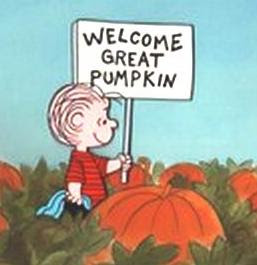
... are the three things Linus van der Pelt said he'd learnt never to talk about. For those of you who don’t know, Linus is a character from the Peanuts cartoon strip (starring Snoopy) by Charles M. Schultz. Fairly early on in his life, Linus creates his own religion by confusing Halloween and Christmas. He lives his life convinced that if he believes hard enough then the great Pumpkin will appear to him and bring him gifts at Halloween.

I mention this because the subject of this blog is parody religions, and when you type parody religions into wiki, you get a list which includes Linus’ worship of the great pumpkin. Personally I’m not sure it should count as Linus is the only one who ever follows it (though he believes in it with an evangelical fervour) but you can’t argue with Wiki (except that you can, and probably should).

Parody religions are definitely a phenomenon of recent times, and owe their existence largely to the Internet. If a man were to turn up at your house and tell you he worshiped a sentient ball of spaghetti, you’d think he was a loony. But for some reason, if he says it on the Internet, he becomes the founder of one of the fastest growing of the parody religions, Pastafarianism or the Church of the flying Spaghetti monster (more on them in future posts).

But what is Parody religion, I hear you cry? Parody religion as a blanket term covers two distinct phenomenon; those groups which are purely spoofs or parodies of other religions, often trying to highlight the ultimate foolishness of religion, and those groups which are in many way genuine religions, but with a slanted or skewed world view which makes them seem at first to be simply a joke. The prime example of the second type of group is the Church of the Blind Chihuahua, which at first glance seems like a joke, but once you delve deeper, you realise they are making a valid point about the way Christianity is practised. They are not tying to convert people to atheism (which it could be argued groups such as the Pastafarians are doing), they are believers, but their world view is slanted and in most cases humorous.

So why write a blog about them? Yeah those zany Pastafarians are kind of cool with their off-beat humour and their pirate costumes, but aren’t ultimately just being silly? Well in many ways, yes. But they also give rise to some interesting questions, such as why do people do this, haven’t they got better things to do and why don’t they just grow up? I intend to examine these (and many more interesting and serious questions) in the months to come.